Prescott’s story reaches far beyond its frontier image. The city stands on Indigenous homelands, became a center of territorial government, and grew through mining, transportation, ranching, and tourism. Explore the people and places behind the modern city.
Introduction to Prescott
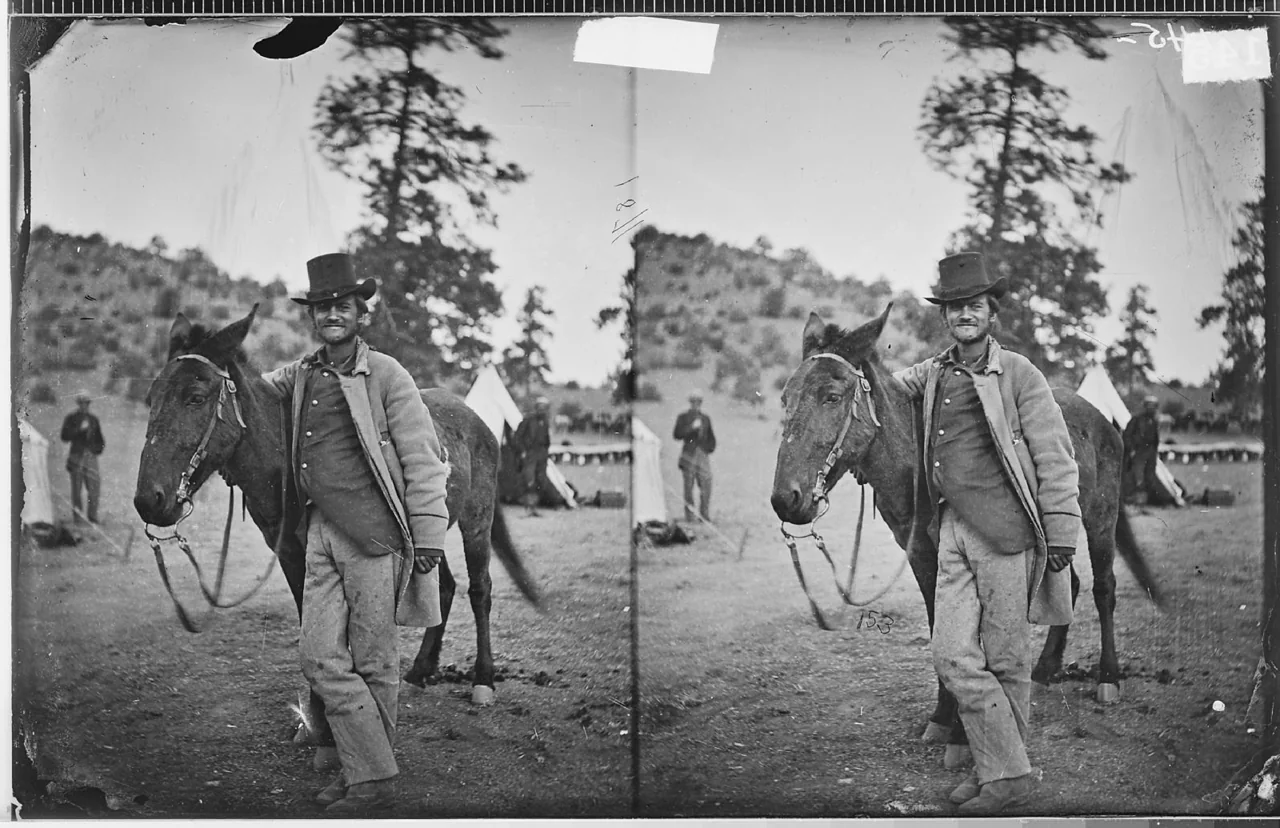
Timothy H. O’Sullivan · National Archives, 106-WA-145 · National Archives: unrestricted use
Archive record ↗
Prescott's history is visible in the short distance between Granite Creek, Courthouse Plaza, and the streets that surround it. Territorial government, mineral discoveries, military activity, and ordinary commercial life all helped shape the town. The saloons are a memorable part of that story, but schools, homes, shops, and ranches tell just as much about how the community endured.
This article begins before the town's founding and follows its connections to the wider Southwest. Reading the surviving buildings alongside museum collections provides a fuller picture, including communities whose stories are less visible in today's streets.
↑ Back to TopIndigenous Peoples and Early History
The Prescott area was a Yavapai homeland long before the arrival of territorial officials and gold seekers. The town's founding date is therefore a milestone in a particular system of government and settlement, rather than the beginning of human history here. The nineteenth century brought dispossession and forced removal; the Prescott Chamber's history acknowledges the displacement of Yavapai people to San Carlos.
The Yavapai-Prescott Indian Tribe's own history records the establishment of its reservation in 1935 on 75 acres of the former Fort Whipple Military Reserve, followed by a 1,320 acre addition in 1956. It also remembers Sam Jimulla and Viola Jimulla as successive tribal leaders. These events belong to a continuing history of community and sovereignty. Contemporary Yavapai life should not be treated as a vanished chapter of the Old West. For a visitor, the most respectful starting point is the Tribe's account of itself, together with Indigenous voices presented in regional cultural institutions.
↑ Back to TopGold Discoveries and the Founding of Prescott
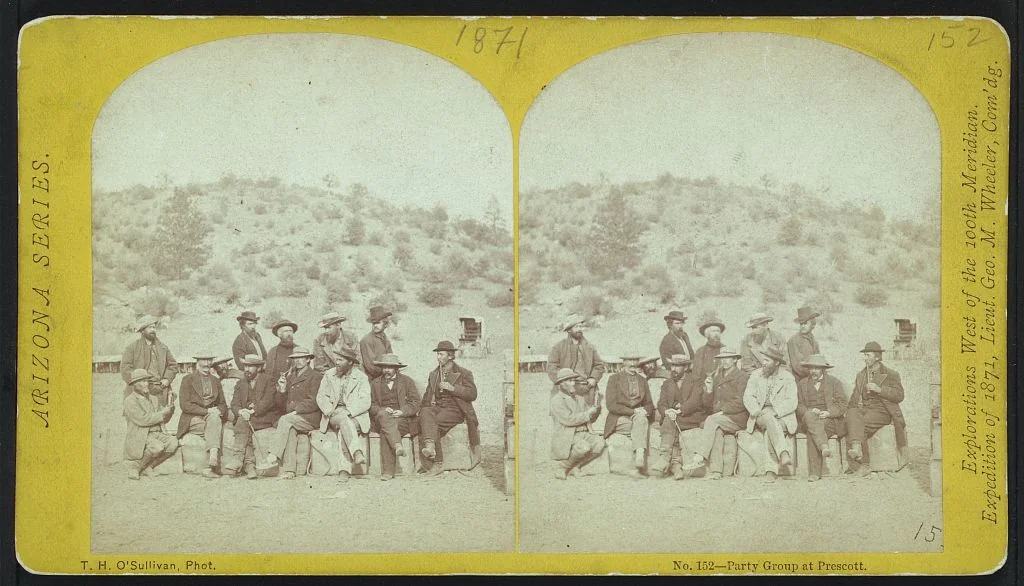
Timothy H. O’Sullivan · Library of Congress, LC-DIG-stereo-1s00178 · No known restrictions on publication (Library of Congress)
Archive record ↗
Gold discoveries in 1863 drew prospectors into the central Arizona highlands. In the following year, the new territorial administration selected Prescott as its capital and the seat of Yavapai County. The town was formally established on May 30, 1864, and named for historian William Hickling Prescott. The choice linked the settlement to a national political and cultural world even while local life depended on rough roads and small mining camps.
The townsite was surveyed in a grid around a central square. That decision still guides a walk downtown: broad streets, rectangular blocks, and a public center make the original plan legible beneath later buildings. The city's Historic Preservation Master Plan treats the original street and lot arrangement as part of Prescott's heritage. Preserving a historic town thus involves more than protecting individual façades; it also means understanding the spaces between buildings and the pattern of movement through them.
↑ Back to TopPrescott as Arizona's Territorial Capital
Prescott served as Arizona's territorial capital twice: from 1864 to 1867 and again from 1877 to 1889. Between those periods, the government operated from Tucson. In 1889 the capital moved permanently to Phoenix. The sequence is sometimes remembered as a capital on wheels, a reminder that political power in the territory remained unsettled as population and economic influence shifted.
The moves also show the limits of nineteenth century transportation. Government records and equipment traveled by freight wagon for the earlier relocations; the final move used rail connections, though no direct Prescott to Phoenix line yet existed. Losing the capital did not erase Prescott's regional importance. Its county seat role and commercial relationships continued, while the old Governor's Mansion became an enduring physical link to the territorial administration. Today's museum visitor can place the political dates beside the much smaller scale of the surviving log residence.
↑ Back to TopFort Whipple and the Military
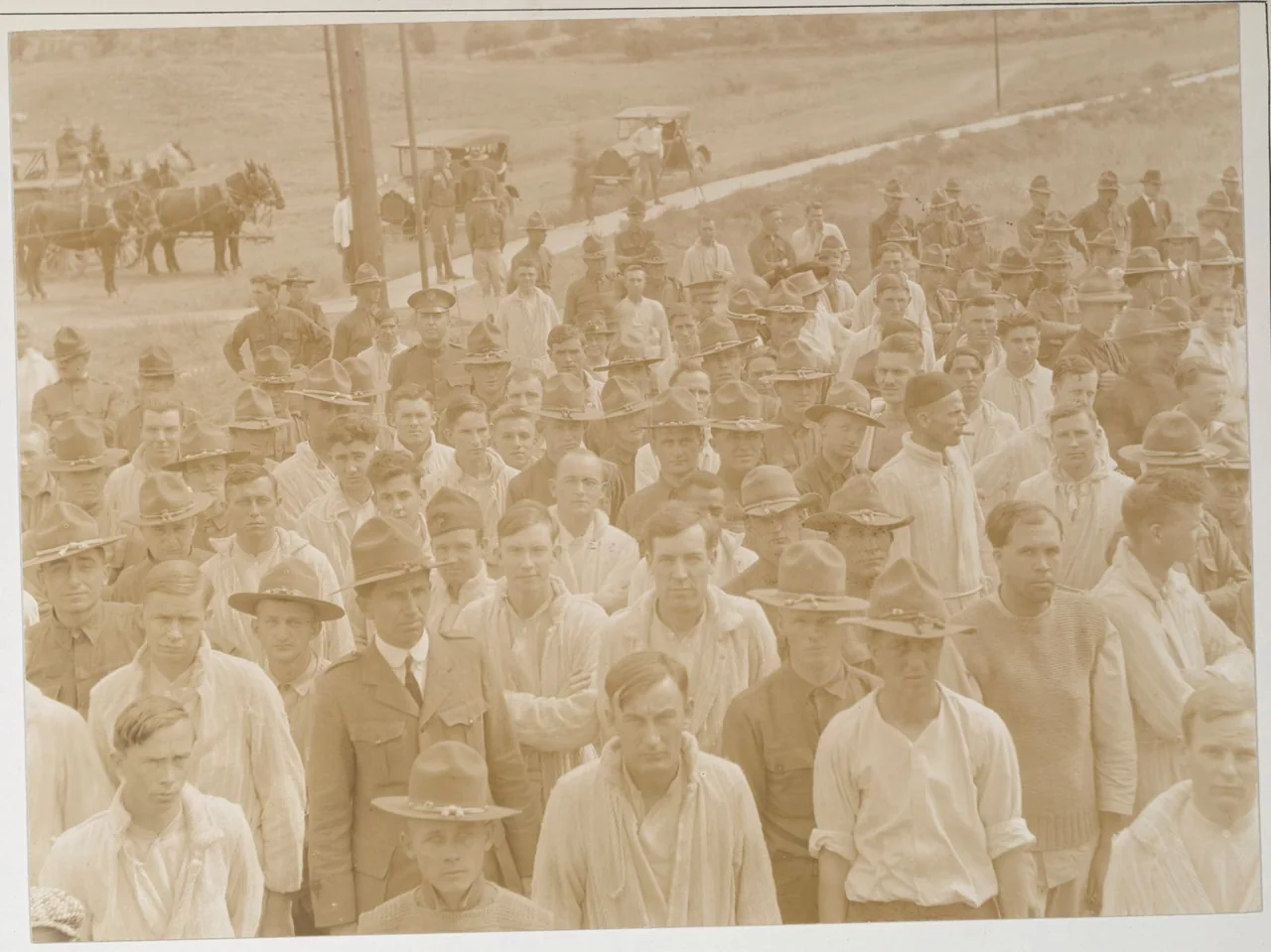
Arizona State Council Defense collection · National Archives, 165-WW-243A-51 · National Archives: unrestricted use
Archive record ↗
Fort Whipple began at Del Rio Springs in December 1863 before moving near Prescott in May 1864. The army post supported federal control in the region and protected the developing territorial capital and incoming settlers. Its history is inseparable from the military campaigns against Indigenous peoples, and should be understood in that wider context rather than solely as a story of frontier buildings.
The site later acquired a different purpose. In 1920 the property was loaned to the U.S. Public Health Service for the treatment of former soldiers, particularly those with tuberculosis. It transferred to the Veterans Bureau in 1922 and to the Veterans Administration in 1931. That sequence connects the military landscape to a long history of medical care. Fort Whipple's surviving buildings and museum help explain how one institutional campus could change function while remaining important to Prescott and to veterans.
↑ Back to TopMining, Ranching, and Everyday Work
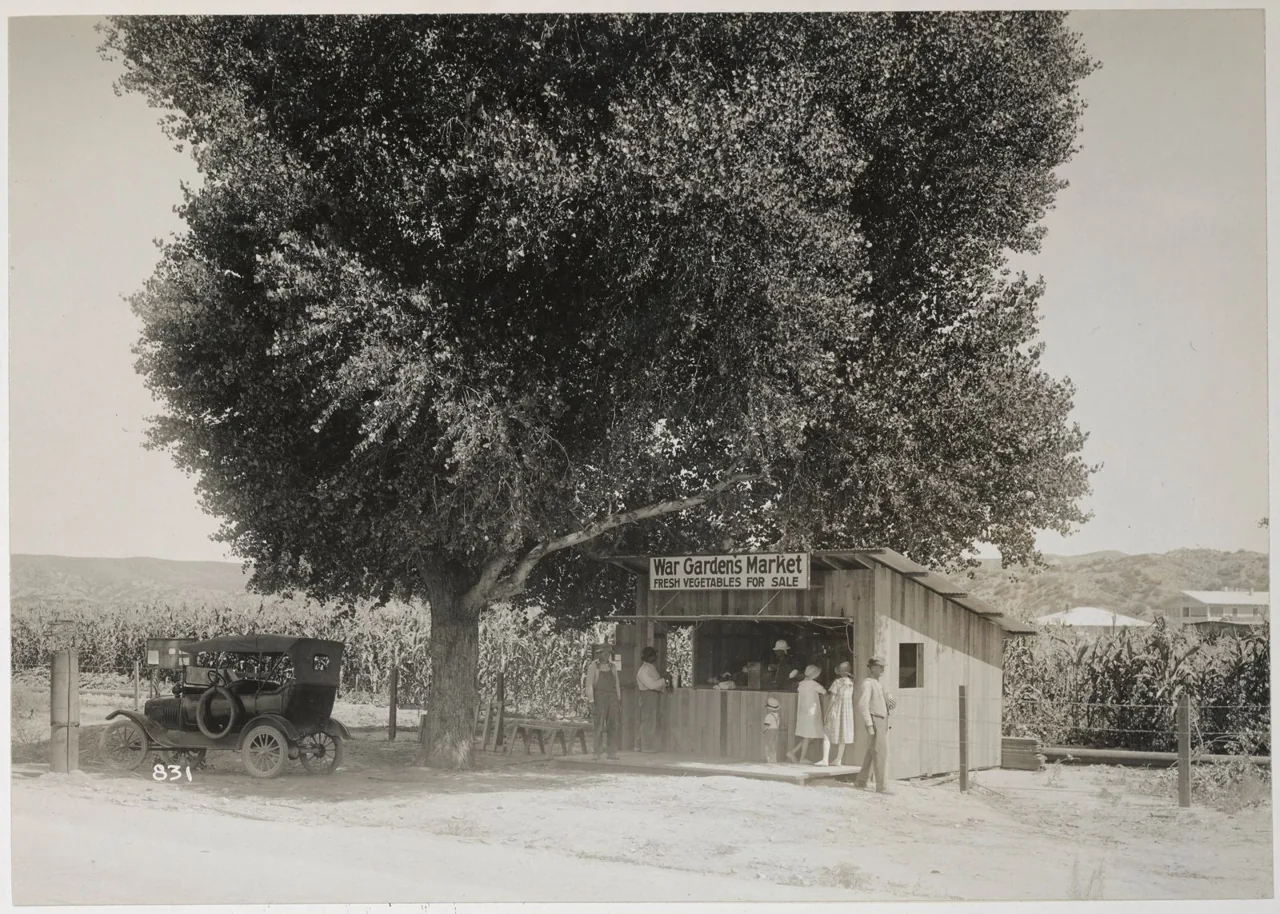
Arizona State Council Defense · National Archives, 165-WW-173A-46 · National Archives: unrestricted use
Archive record ↗
The early Prescott economy rested on more than striking a rich claim. Mining camps needed food, transport, tools, and services; ranching and farming linked rural households to town markets. The Hall family's experience at Orchard Ranch illustrates the varied work behind a frontier livelihood. By the 1890s the family raised livestock and poultry, grew vegetables, and planted fruit trees. Horses supplied both transportation and working power.
Such households depended on labor throughout the year, inside and outside the home. Sharlot Hall's life as a ranch woman helps widen the familiar image of the lone cowboy to include cooking, washing, dairying, animal care, gardening, and the management of scarce resources. Drought and flood could overturn plans just as quickly as changing markets. This combination of practical knowledge, family labor, and environmental uncertainty belongs at the center of Prescott's Old West story.
↑ Back to TopWhiskey Row and Its Famous Saloons
Sanborn Map Company · Library of Congress, Geography and Map Division, Sanborn Maps Collection · Public domain; free to use and reuse (Library of Congress)
Archive record ↗
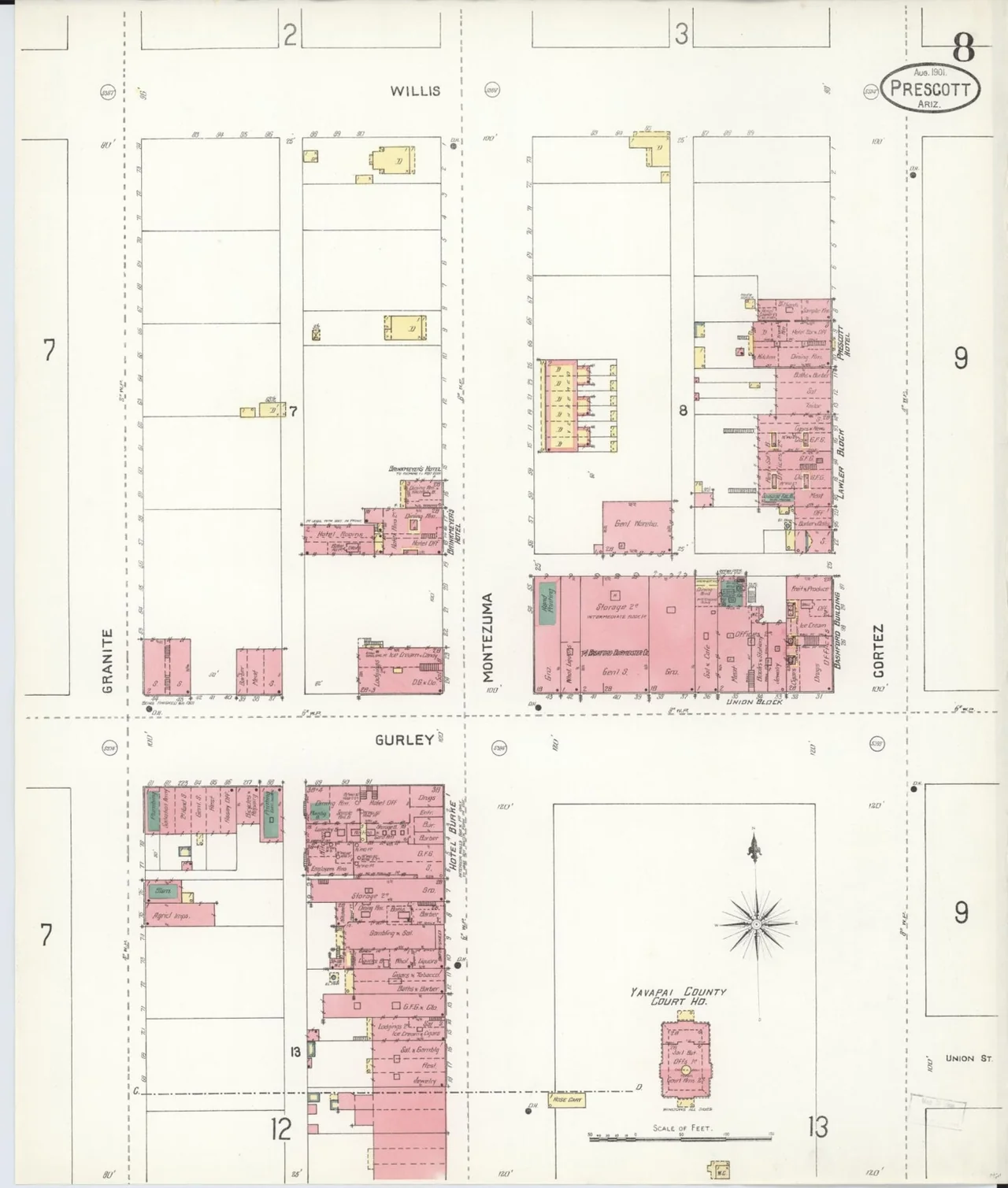
The Montezuma Street frontage west of the plaza became Prescott's best known saloon district. Businesses and proprietors changed repeatedly, and fires repeatedly altered the street. Museum historian Brad Courtney's work on D. C. Thorne traces the Cabinet Saloon's opening in 1874, competition with the Palace, and the eventual combination of the businesses after the 1900 fire. The present Palace building belongs to that rebuilding period, rather than surviving intact from the earliest mining years.
Whiskey Row worked as a commercial and social district as well as a place to drink. Its establishments competed for customers through entertainment, elaborate interiors, and other attractions. A careful walk looks beyond famous names to building materials, lot widths, and changes of use. Stories about gunfighters can be engaging, but precise claims about who visited a particular room or bar require evidence. The district's documented business history is rich enough to stand on its own.
↑ Back to TopThe Great Fire of 1900
The San Francisco Call · Library of Congress, Chronicling America · digitized by the University of California, Riverside · Public domain in the United States; published 1900
Archive record ↗
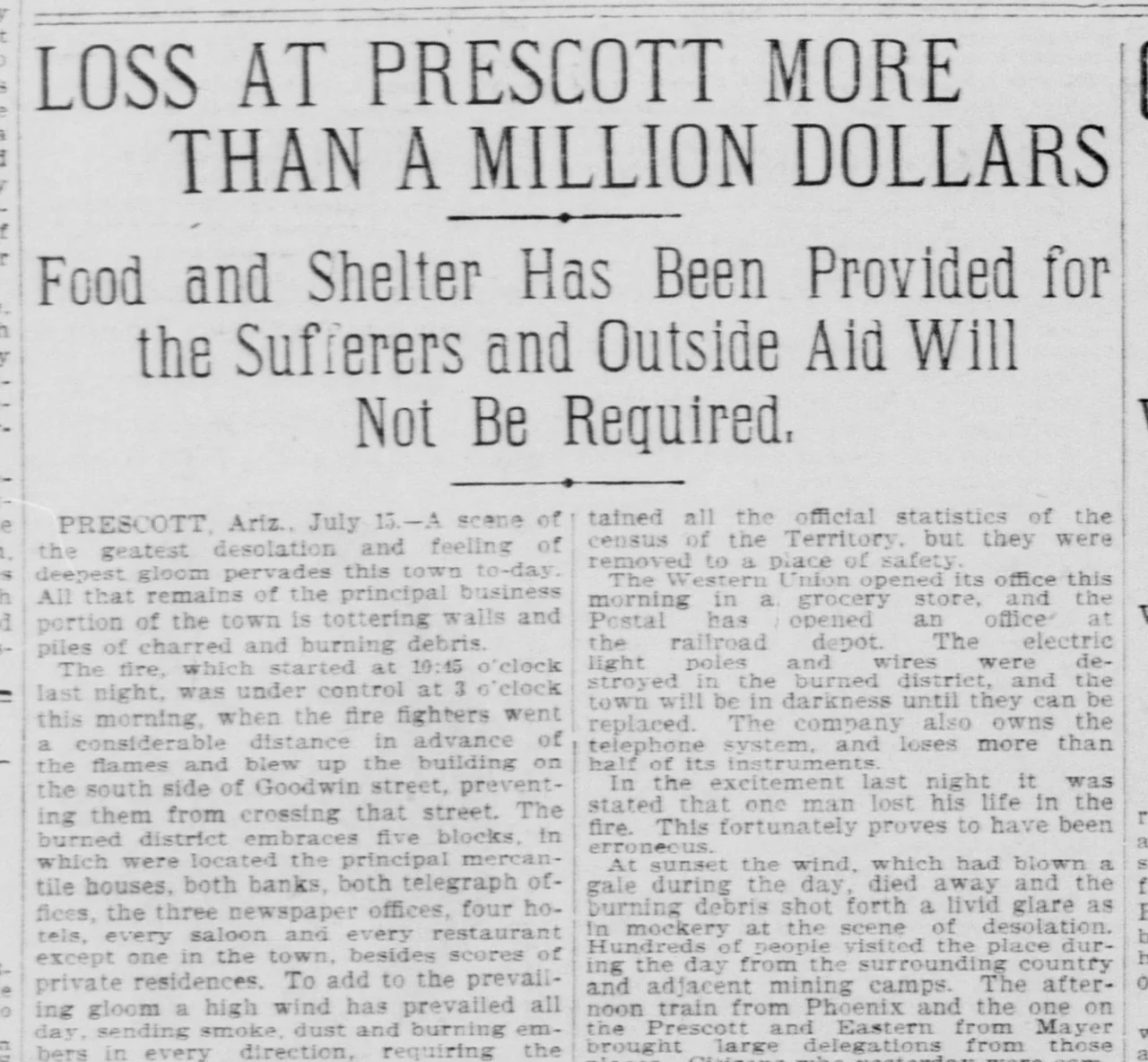
On the night of July 14, 1900, a major fire swept through Prescott's business district. Flames crossed streets and consumed buildings on Whiskey Row and beyond. The disaster exposed the danger of concentrated commercial buildings and inadequate firefighting water. It also interrupted livelihoods: the loss was measured not only in structures, but in stock, equipment, workplaces, and the ordinary routines of trade.
Business resumed quickly in temporary quarters on Courthouse Plaza while reconstruction began. Masonry replaced much of the burned commercial fabric, giving the downtown a more substantial appearance. The Palace was among the establishments rebuilt in 1901. As a result, a visitor looking at Prescott's historic streets is often seeing the response to the fire rather than the town that preceded it. The plaza served as an emergency business district before returning to its familiar civic role.
↑ Back to TopDocumented History and Local Folklore
Repeated stories can become more certain in the telling than the evidence allows. The claim that a miner's candle caused the Great Fire is a useful example. In a 2017 Sharlot Hall Museum article, Brad Courtney notes that Tony Johns, an undersheriff at the time and later a fire chief, regarded the ignition as a mystery. Different versions of the candle story appeared after the disaster.
This does not make every memorable local story worthless. Folklore reveals what later generations found dramatic, funny, or meaningful. It should, however, be labeled as tradition when records do not establish it. Dates, property records, contemporary newspapers, photographs, and later recollections offer different kinds of evidence. A museum interpretation can acknowledge uncertainty while still telling a compelling story. PrescottGO treats ghost stories, unexplained origins, and disputed saloon anecdotes as folklore unless a reliable source documents the specific claim.
↑ Back to TopThe Railroad and Prescott's Growth
Bates, Prescott, Arizona · National Archives, 165-WW-243A-48 · National Archives: unrestricted use
Archive record ↗
Railroad development connected Prescott's mines and merchants to larger markets, but the process included competing routes and businesses. The railroad rivalry of the early 1890s ended with the failure of the older Bullock line. Completion of the Prescott to Phoenix portion of the Santa Fe, Prescott and Phoenix Railway in spring 1895 strengthened the town's place in a regional network. Branches serving mining districts made Prescott an operational center for a time.
Those relationships changed as mines declined and routes were abandoned. The last passenger train departed for Phoenix in 1962, and a bypass removed Prescott from the through route. Old rail corridors acquired new uses: parts of the former transportation landscape now support trails around the city. Walking an old grade provides a physical sense of how engineering linked the highlands to distant markets. The gentle slope and broad curve of a rail alignment differ noticeably from trails designed simply for hiking.
↑ Back to TopChinese Residents and a Lost Neighborhood
Chinese residents contributed to Prescott's economy from the late 1860s, working in businesses and services that supported the wider community. Granite Street, between Goodwin and Gurley, became the center of a Chinatown whose buildings combined commercial and residential uses. Maps, newspapers, and surviving records help reconstruct a neighborhood that is no longer visible as it once was.
The community faced discrimination and exclusion alongside the everyday challenges of making a living. Federal immigration restrictions and local hostility constrained opportunity, while fires, floods, economic shifts, and the loss of jobs further weakened the neighborhood. Street improvements and redevelopment in the 1930s removed its remaining physical traces. Remembering this history changes a downtown walk: an apparently ordinary street also marks the location of homes, shops, social ties, and cultural practices that are easily missed in a history focused only on saloons and public monuments.
↑ Back to TopPrescott Frontier Days and the Rodeo
Prescott's rodeo tradition dates to a formal cowboy tournament held on July 4, 1888, with cash prizes organized by local merchants and businessmen. The event transformed working ranch skills into a public contest. Prescott Frontier Days presents this history under the registered identity World's Oldest Rodeo, emphasizing the organized and recurring character of the local event.
The rodeo changed as audiences and facilities grew. The Frontier Days name came into use in 1913, when the celebration moved to the grounds associated with today's rodeo venue. Later construction, promotion, and participation helped turn a local gathering into a major civic occasion. The history connects downtown commerce, rural work, entertainment, and tourism rather than belonging to the arena alone. Visitors should use the organizer's current calendar for dates and tickets; the historic Fourth of July association does not establish the schedule or availability of any particular performance.
↑ Back to TopSharlot Hall and Historic Preservation
Sharlot Mabridth Hall arrived in Arizona with her family in 1882 and developed a lasting interest in the region's people, landscape, and history. A writer and collector, she recognized that objects and personal memories could disappear as the territorial generation aged. Her appointment as Territorial Historian in 1909 gave public recognition to work she had already pursued with determination.
Hall's museum project joined the preservation of a building to the preservation of evidence. In 1927 she agreed to move her collection into the old Governor's Mansion, and the museum opened on June 11, 1928. After her death in 1943, others continued the work. The resulting institution is both a place to visit and a research resource. Its collections remind readers that history survives because people make choices to gather, describe, conserve, and share it. The mansion's present role owes as much to that twentieth century effort as to its original territorial occupants.
↑ Back to TopHistoric Buildings and Courthouse Plaza
National Archives, 165-WW-234B-7 · National Archives: unrestricted use
Archive record ↗
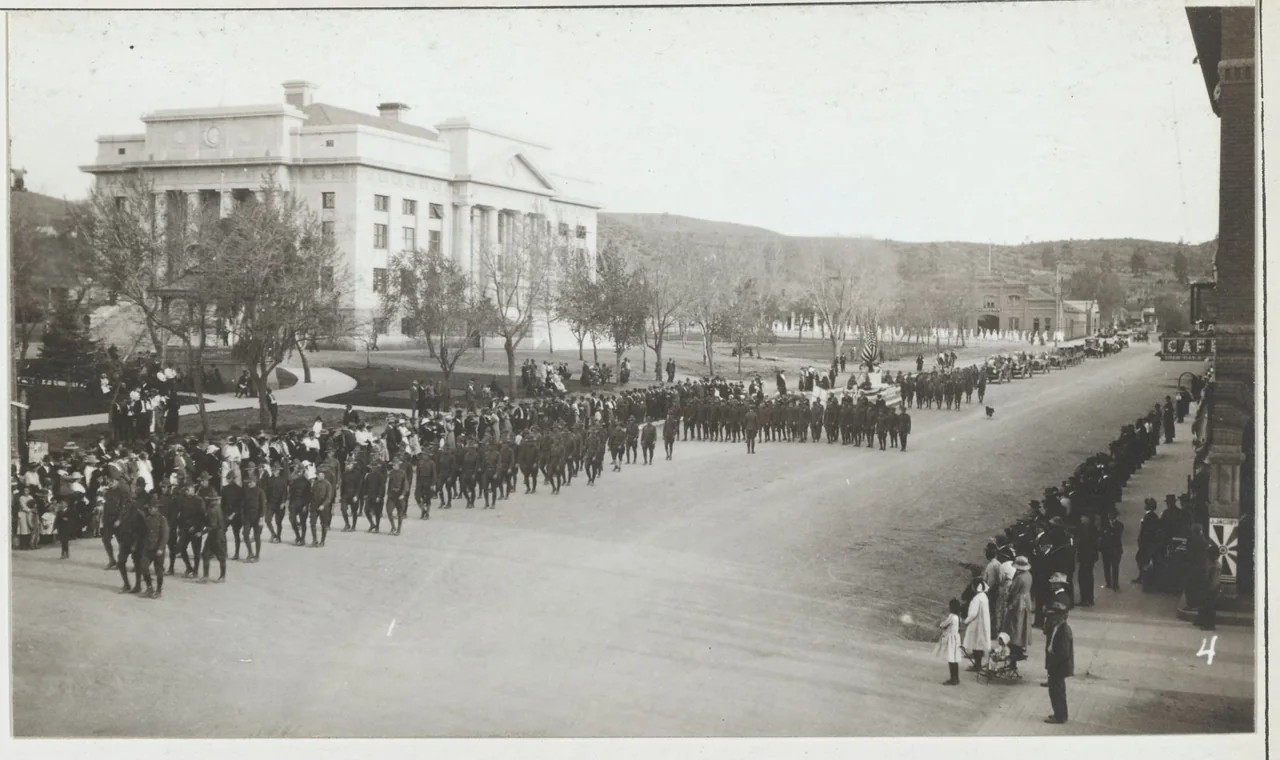
Courthouse Plaza remains the organizing space of downtown Prescott. Its current courthouse, designed by William N. Bowman and built between 1916 and 1918, is a Classical Revival civic building faced in granite and terra-cotta. Monumental entrances and columns give the structure a public presence distinct from the smaller commercial frontages around it. The building replaced earlier courthouses on the plaza.
The open space has its own history of landscaping, monuments, public gatherings, and commemoration. It has served as a setting for celebrations and political events as well as the daily business of a county seat. A visitor can read these layers by looking both at the courthouse and at the surrounding grounds. Civic architecture records what a community chose to make permanent and prominent; the plaza also remains a place where later generations continue to give those spaces new meanings.
↑ Back to TopPrescott in the Twentieth Century

California Panorama Co. · Library of Congress, Prints and Photographs Division, 2007661388 · No known restrictions on publication (Library of Congress)
Archive record ↗
Prescott's twentieth century history extends beyond the preservation of its nineteenth century image. Medical institutions, education, and public recreation expanded the ways people lived and worked here. At Fort Whipple, the treatment of tuberculosis and the growth of veterans' care connected the city to national systems of public health. Later educational investment added another lasting institution: voters approved Yavapai College in 1966, and construction began on its first Prescott campus in 1968.
Recreation also grew out of infrastructure. The city's account of Goldwater Lake traces its origins to a dam built on Bannon Creek in the early 1930s for water supply. Its later use for picnicking, walking, fishing, and paddling shows how a utilitarian landscape could become a public amenity. These changes placed new uses alongside older streets and buildings, producing the mix of institutions, neighborhoods, parks, and historic attractions that visitors encounter today.
↑ Back to TopModern Prescott and Remembrance
Modern Prescott combines an active historic center with surrounding neighborhoods and recreation areas. Preservation remains a practical civic responsibility, expressed through historic districts, review of exterior work, and guidance for building owners. Maintaining the character of an old town involves continuing decisions about repair, use, and change rather than keeping the entire city fixed in one period.
Recent history also includes loss and remembrance. On June 30, 2013, nineteen members of the Granite Mountain Interagency Hotshot Crew died while fighting the Yarnell Hill Fire. Prescott continues to commemorate their service. The Learning and Tribute Center and the preservation of tribute materials show another form of historical work: collecting the responses of a community while memories are still immediate. Such remembrance belongs alongside the better known territorial stories, connecting Prescott's past to the people who live with its consequences today.
↑ Back to TopHistorical Timeline
1863 — Gold discoveries attract prospectors; Fort Whipple is established at Del Rio Springs.
1864 — Fort Whipple moves near Prescott; Prescott is established on May 30 as territorial capital and county seat.
1867 — The territorial capital moves to Tucson.
1877 — Prescott again becomes the territorial capital.
1888 — Prescott's organized cowboy tournament begins on July 4.
1889 — The territorial capital moves permanently to Phoenix.
1895 — The railroad connection from Prescott to Phoenix is completed.
1900 — The Great Fire devastates the downtown business district on July 14.
1909 — Sharlot Hall is appointed Territorial Historian.
1916–1918 — The present Yavapai County Courthouse is built.
1928 — Sharlot Hall's museum opens on June 11.
1935 — The Yavapai-Prescott reservation is established.
1966 — Voters approve Yavapai College.
2013 — Nineteen Granite Mountain Hotshots die in the Yarnell Hill Fire.
Historic Places to Visit
Start at Courthouse Plaza and walk the adjoining streets to see the relationship between public space and commercial Prescott. Continue west to Sharlot Hall Museum for the old Governor's Mansion, historic buildings, exhibits, and research collections. These sites reward a slower visit that compares the surviving physical evidence with the dates and events in this article.
The Museum of Indigenous People presents cultural materials and contemporary Indigenous art, while the Phippen Museum explores Western art and heritage. Fort Whipple Museum adds the military and medical dimensions of the region's history. Each institution has its own admission arrangements, access conditions, and calendar. Follow their official visitor information before setting out. Our museum circuit and self guided downtown walks connect these places with the relevant chapters of Prescott's history.
↑ Back to TopReferences and Further Reading
The source links attached to each section lead to the institutions and research used for this article. Begin with Sharlot Hall Museum's Days Past archive for focused studies based on newspapers, photographs, documents, and local collections. The City of Prescott's preservation resources explain the street plan, districts, and built environment. The Yavapai-Prescott Indian Tribe's history provides an essential account of its own community, and the Department of Veterans Affairs documents Fort Whipple's later institutional history.
The Arizona Memory Project, maintained by the Arizona State Library, offers further archival material for readers who want to investigate beyond a visitor's overview. Compare the date and purpose of a source with the claim being made. Older visitor maps and business listings are useful evidence of their period, but should not be used to establish current hours, admission, or operating status.
↑ Back to TopHistorical Photos
Press a small color wheel to show an AI-colorized version of that photo. These are interpretations: colors and small details may differ from the historical original. Click a photo to open the full-screen viewer.
Fred W. Loring and his mule in Prescott, 1871. The paired photographs are a stereograph.
Timothy H. O’Sullivan · National Archives, 106-WA-145 · National Archives: unrestricted use · Archive record ↗
A war garden market in Prescott during the World War I era. The archival card records receipt in December 1918; the photograph’s exact date is not specified.
Arizona State Council Defense · National Archives, 165-WW-173A-46 · National Archives: unrestricted use · Archive record ↗
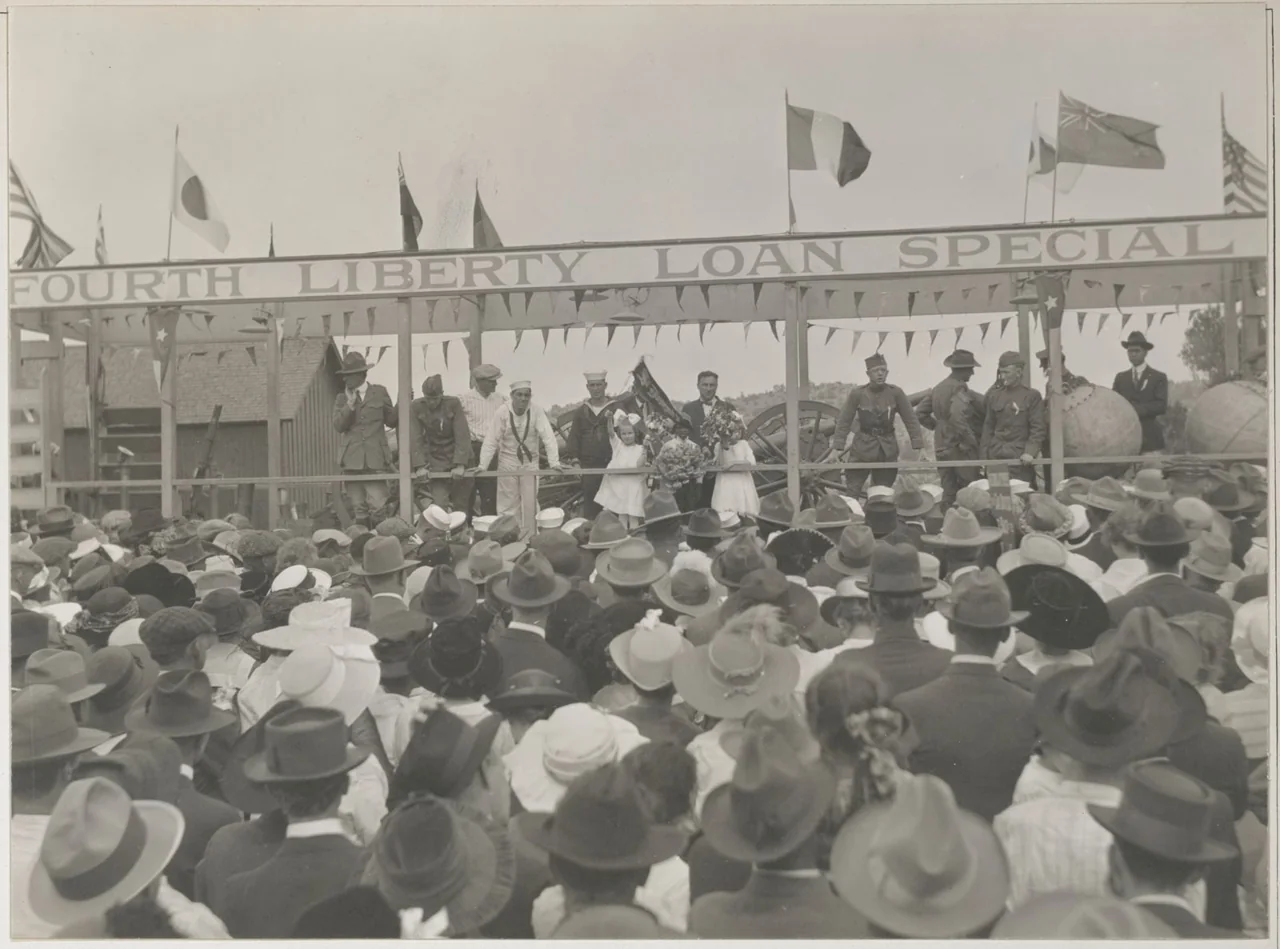
The Liberty Loan Special arrives in Prescott, October 3, 1918.
Bates, Prescott, Arizona · National Archives, 165-WW-243A-48 · National Archives: unrestricted use · Archive record ↗
Soldiers recuperating at Whipple Barracks watch the Liberty Loan Special, October 3, 1918.
Arizona State Council Defense collection · National Archives, 165-WW-243A-51 · National Archives: unrestricted use · Archive record ↗
A Fifth Liberty Loan parade around Prescott’s plaza. The archive does not supply an exact photograph date.
National Archives, 165-WW-234B-7 · National Archives: unrestricted use · Archive record ↗
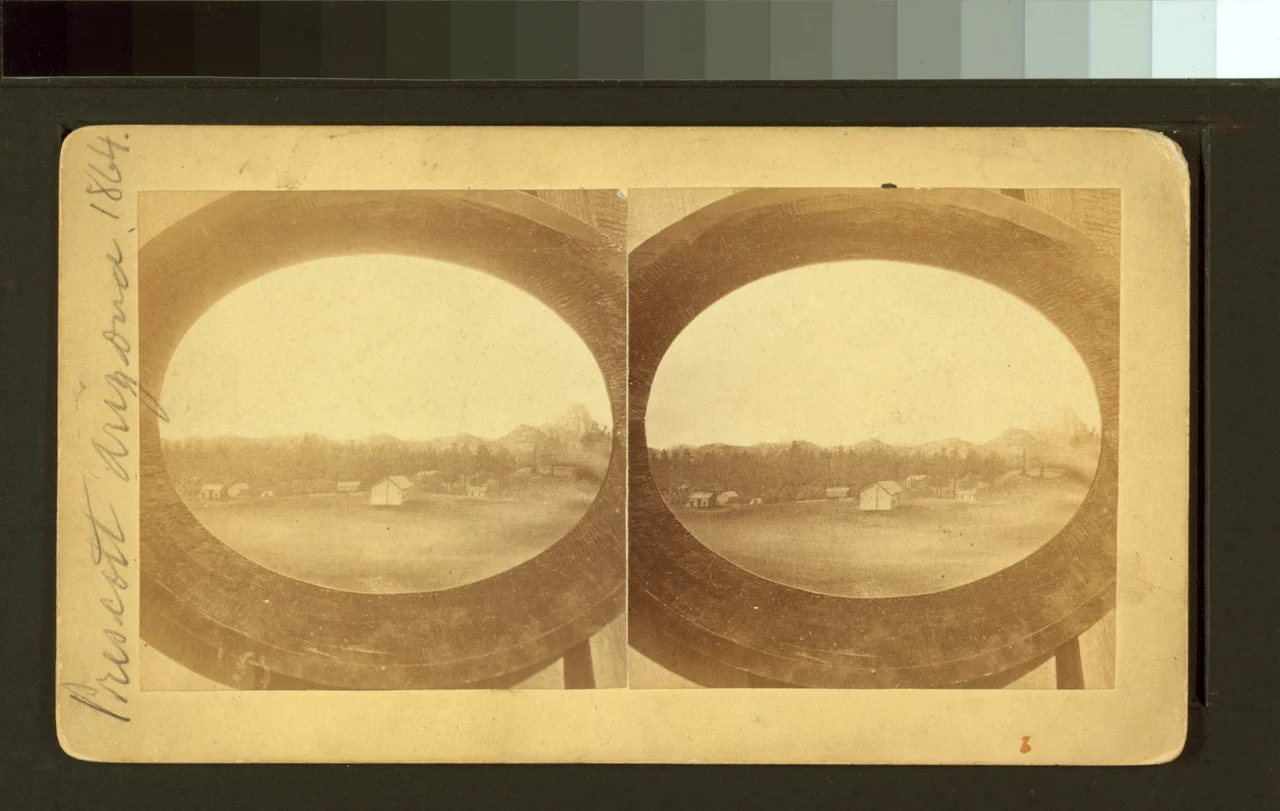
An early Prescott view titled “Prescott in 1864.” Matching NYPL card metadata dates the stereograph’s creation to about 1880 and identifies 1864 as the depicted date; the title is not treated as the exposure date. Both stereoscopic views are preserved.
D. F. Mitchell · New York Public Library, G88F121_007ZF · scan via Wikimedia Commons · Public domain, as identified by the Wikimedia Commons item license; NYPL archival scan · Archive record ↗
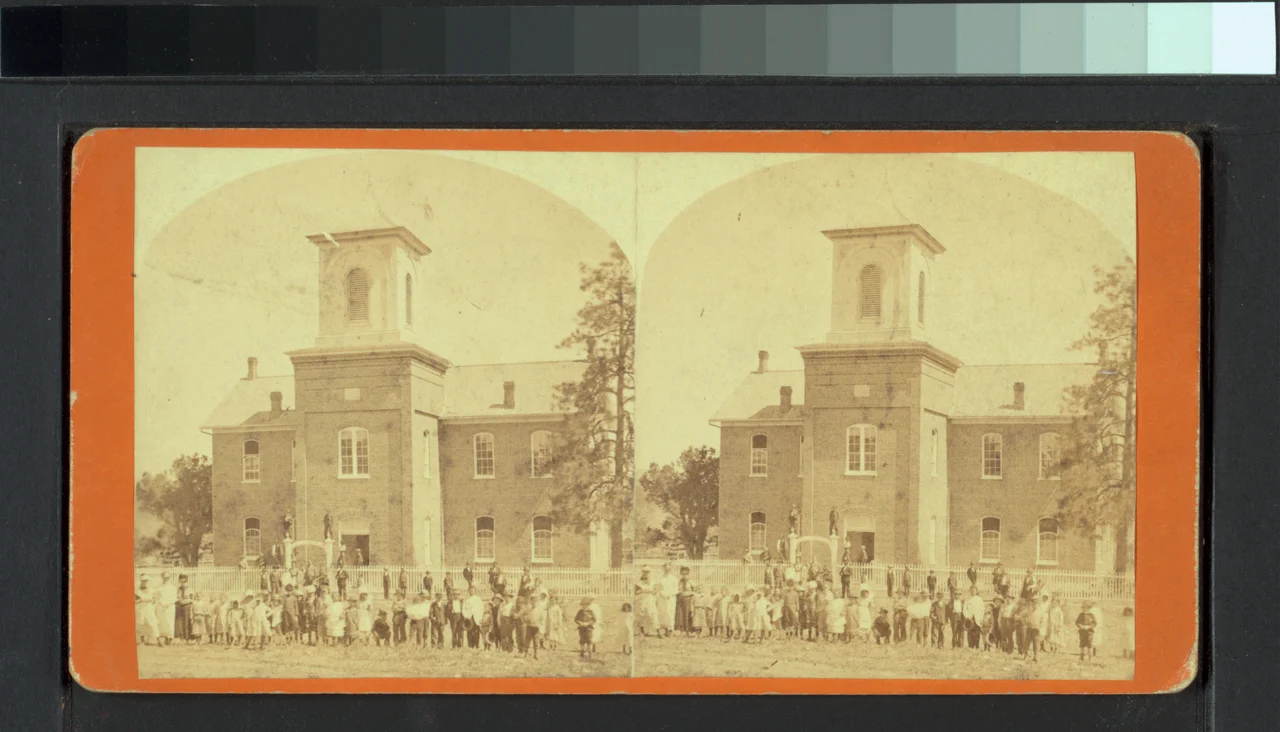
Prescott’s schoolhouse and pupils, circa 1880, in a D. F. Mitchell stereograph. The matching NYPL card metadata supplies the approximate date; an isolated 1864 date on another copy is not used as the photograph date. Both views and the original card are retained.
D. F. Mitchell · New York Public Library, G88F121_004F · scan via Wikimedia Commons · Public domain, as identified by the Wikimedia Commons item license; NYPL archival scan · Archive record ↗
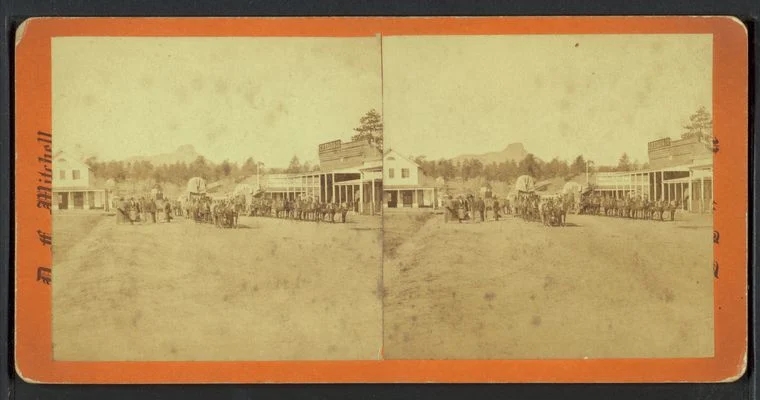
Freighting teams in Prescott, circa 1880. D. F. Mitchell’s paired photographs show wagons, teams and commercial buildings, documenting the town’s freight activity. The original stereograph card and lettering are preserved.
D. F. Mitchell · New York Public Library, G88F121_005F · scan via Wikimedia Commons · Public domain, as identified by the Wikimedia Commons item license; NYPL archival scan · Archive record ↗
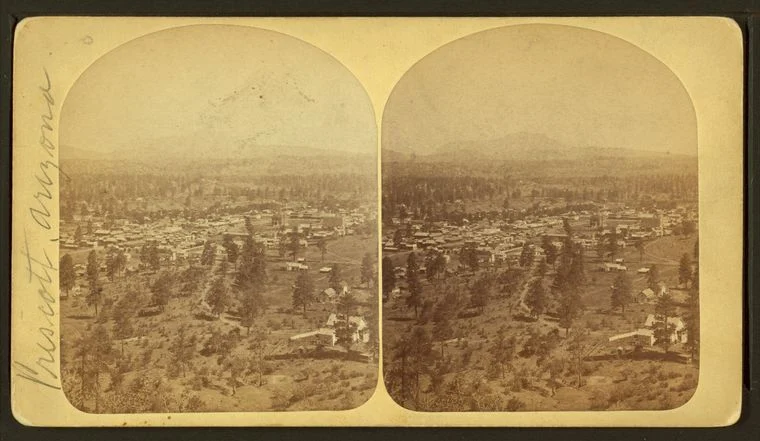
Prescott from the southeast, approximately the 1880s. D. F. Mitchell’s stereograph looks across the growing town and its wooded surroundings. The archive gives an approximate decade rather than an exact photograph date.
D. F. Mitchell · New York Public Library, G88F121_008ZF · scan via Wikimedia Commons · Public domain, as identified by the Wikimedia Commons item license; NYPL archival scan · Archive record ↗
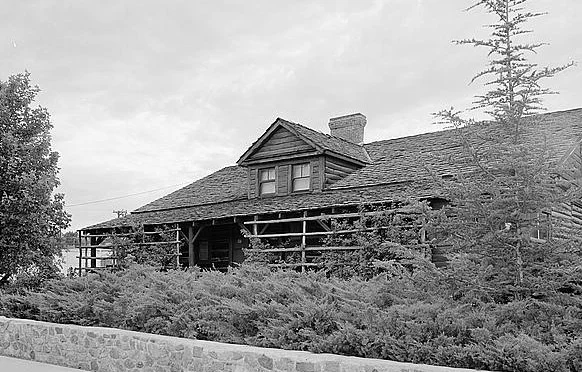
Prescott’s territorial Governor’s Mansion in an August 1975 photograph by Jack E. Boucher for the Historic American Buildings Survey. The building dates to 1864; 1975 is the photograph date. View from the northeast toward the front facade.
Jack E. Boucher · HABS / Library of Congress, HABS ARIZ,13-PRESC,1-4 · scan via Wikimedia Commons · Public domain U.S. Government photograph; Library of Congress HABS rights advisory and Wikimedia Commons item license · Archive record ↗
Prescott History Podcasts
Listen to local history and heritage conversations at their original publishers. Check episode dates and topics in each archive.
The Whiskey Row History Show
Local historian Brad Courtney and Ron Williams discuss Whiskey Row and Prescott history, including the Great Fire of 1900. Episodes also include folklore and tall tales.Ride With Us — Prescott Frontier Days
The official Prescott Frontier Days podcast explores the people, history and traditions behind Prescott’s World’s Oldest Rodeo, alongside current rodeo conversations.
Find more local podcasts in Media Outlets.
Prescott History Videos
Longer documentaries, local history programs and museum talks about Prescott. Every video is at least 20 minutes. Runtimes are shown as minutes:seconds, or hours:minutes:seconds for programs over an hour.
 58:02
Whiskey Row & the Great Fire of 1900
Brad Courtney explores Whiskey Row and the Great Fire of 1900.
City Of Prescott · Local history program
Watch on YouTube ↗ 25:15
Prescott's Western Heritage | Arizona Highways TV (Full Episode)
Arizona Highways explores Prescott’s Western heritage, Whiskey Row and Frontier Days.
Arizona’s Family (3TV / CBS 5) · Full television feature
Watch on YouTube ↗ 48:50
Prescott History Hour - Episode 01
John Krizek and Nancy Burgess present a photographic tour of 1916 Prescott.
Prescott Channel 64 · Photographic history program
Watch on YouTube ↗ 56:21
Prescott History Hour - Episode 02
Another Prescott History Hour episode featuring the channel’s photographic exploration of 1916 Prescott.
Prescott Channel 64 · Photographic history program
Watch on YouTube ↗ 50:17
Doc, the Earps, and the Art of the West: When Legends Come Home to Prescott
Sharlot Hall Museum discusses Doc Holliday, the Earps and their portrayal in Western art.
Sharlot Hall Museum · Museum conversation
Watch on YouTube ↗ 43:13
Prescott Today - Phippen Museum
A City of Prescott program focused on the Phippen Museum.
City Of Prescott · Local museum program
Watch on YouTube ↗ 50:28
SHM Lecture Series: The History of Railroads in Prescott
Tom McColloch follows Prescott’s former rail routes using historical photographs and surviving landmarks.
Sharlot Hall Museum · Museum lecture
Watch on YouTube ↗ 53:28
SHM Lecture Series: The Life & Legacy of Sharlot M. Hall
Bailey Cacciatore examines Sharlot Hall’s life, preservation work and the creation of her museum.
Sharlot Hall Museum · Museum lecture
Watch on YouTube ↗ 1:06:16
SHM Lecture Series- The Wild, Wild Western: How Prescott Launched Arizona’s Famous Film Industry
Stuart Rosebrook discusses Prescott’s role in the beginnings of Arizona’s motion-picture industry.
Sharlot Hall Museum · Museum lecture
Watch on YouTube ↗ 34:08
SHM Lecture Series: Meet Grace Sparkes: Prescott’s #1 Booster
Brenda Cusick portrays Grace Sparkes and explores her influence on Prescott’s civic life and rodeo heritage.
Sharlot Hall Museum · Costumed historical presentation
Watch on YouTube ↗ 1:07:02
SHM Lecture Series: Doc Holliday and Kate in Prescott
Bradley Courtney explores Doc Holliday and Kate’s Prescott connections, including efforts to record Kate’s memories.
Sharlot Hall Museum · Museum lecture
Watch on YouTube ↗ 51:49
SHM Lecture Series: “The Tombstone-Prescott Connections” PART I
Bradley Courtney discusses the Prescott connections of people who later became prominent in Tombstone.
Sharlot Hall Museum · Museum lecture · Part I
Watch on YouTube ↗ 53:33
SHM Lecture Series: “The Tombstone-Prescott Connections” PART II
Ron Williams continues the two-part program on the people and relationships linking Prescott and Tombstone.
Sharlot Hall Museum · Museum lecture · Part II
Watch on YouTube ↗ 47:53
Western History Symposium: "True Crime in Frontier Prescott"
Brad Courtney and Drew Desmond discuss crime and law enforcement in early Prescott.
Sharlot Hall Museum · Museum symposium talk
Watch on YouTube ↗ 54:27
Prescott History Hour - Episode 03
John Krizek joins Jay Eby and Dave Williamson to discuss Bucky O’Neill and the Rough Riders.
Prescott Channel 64 · Local history program
Watch on YouTube ↗ 1:59:50
Prescott History in Pictures and Stories
Dallas Eggers uses historical photographs to tell stories about Prescott residents and local events.
Prescott Community Television · Photographic history presentation
Watch on YouTube ↗ 43:10
Prescott Today - Sharlot Hall Museum
A City of Prescott visit explores Sharlot Hall and the historic buildings on the museum grounds.
City Of Prescott · Local museum program · 2022
Watch on YouTube ↗ 59:22
Tom Slaback Presents on Film History in Yavapai County
Film historian Tom Slaback discusses filmmaking in Prescott and Yavapai County in a 2015 Prescott College presentation.
PrescottCollegePR · Recorded college lecture
Watch on YouTube ↗ 1:05:28
SHM Lecture Series: Diamonds in the Desert-Arizona’s First Professional Sport
Stuart Rosebrook traces Arizona baseball’s early development, including Prescott’s nineteenth-century team.
Sharlot Hall Museum · Museum lecture
Watch on YouTube ↗ 44:10
From Milk Pails to Fuel Trucks: The Bennett-Bateman Legacy in Prescott, Arizona.
Lenora Bennett-Bateman shares family memories and the story of a long-established Prescott business.
Sharlot Hall Museum · Local oral-history conversation
Watch on YouTube ↗ 26:00
County Wide August 22 2017 Fort Whipple Museum
Mick Woodcock discusses Fort Whipple Museum in an archival County Wide interview. Visiting details may have changed.
VerdeValleyTV Studio G · Museum interview · 2017
Watch on YouTube ↗ 58:48
SHM Lecture Series: Central Arizona as a Crossroads in the Past and Present
Archaeologist Matthew Peeples examines cultural exchange in central Arizona and the Verde Valley, adding regional Indigenous-history context.
Sharlot Hall Museum · Museum lecture · regional context
Watch on YouTube ↗ 1:06:23
The Origins of Whiskey Row | Whiskey Row History Show
Ron Williams and Bradley Courtney discuss how Prescott’s Whiskey Row developed in its early years.
Talking Glass Media · Video podcast
Watch on YouTube ↗ 39:33
Murder, Mystery, and the Hanging That Shook Prescott | The Whiskey Row History Show
Ron Williams and Bradley Courtney discuss Dennis Dilda’s case and its place in Prescott’s early criminal-justice history.
Talking Glass Media · Video podcast
Watch on YouTube ↗